10 Crochet Baby Blanket Patterns: Easy & Adorable Designs
Find free crochet baby blanket patterns for beginners and pros. Easy, cute designs with step-by-step instructions for every skill level.
Why Crochet Baby Blankets Are the Perfect Project
There is something quietly magical about handing someone a blanket you made with your own hands. I have been crocheting since I was old enough to hold a hook without poking my thumb through my sock, and after more than two decades, baby blankets remain my absolute favorite projects to start. They are forgiving, deeply personal, and honestly, they make people light up in a way a handmade scarf sometimes just does not. When you crochet a baby blanket yourself, you choose every single detail: the softness against newborn skin, the colors that match a nursery wall, the texture that will actually survive thirty cycles through the washing machine. Store-bought blankets cost anywhere from forty to eighty dollars for what you often get, and they rarely fit the exact square footage you need for a real crib versus a rocking chair.
The other benefit nobody mentions enough is the quiet pride you feel when you fold that finished piece and tuck it into a gift bag. I still remember wrapping a pale yellow receiving blanket for my goddaughter. She is three now, and her mother told me the baby fell asleep on it every single time. That kind of loyalty to a handmade item? I would not trade it for anything.
What to Look for in a Crochet Baby Blanket Pattern
Before you cast on or make a foundation chain, take a moment to read the whole pattern first. Seriously. I once started a beautiful ripple blanket only to realize halfway through that the designer wanted me to seam it into a duvet cover shape. Frustrating, to say the least. A good beginner-friendly pattern will clearly state the finished dimensions, the recommended yarn weight, the suggested hook size, and the skill level. Look for patterns that explain their abbreviations instead of assuming you already speak fluent crochet. Phrases like “work in rounds,” “join with sl st,” and “chain 1” should never feel like a secret code.
Safety is non-negotiable for baby items. Avoid patterns with long tassels, loose pom-poms, buttons, or novelty yarns that shed fibers. Babies explore everything with their mouths, and a blanket should be safe enough to cuddle without becoming a choking hazard. Choose stitch patterns that lie relatively flat, avoid exposed seams, and keep the fabric dense enough to block drafts but breathable enough to prevent overheating.
You will probably wonder a few things while scrolling through pattern sites. What finished size should I actually make? How do I know if a pattern is truly beginner-friendly? Is this stitch going to curl into a taco shell? The honest answer is that a good pattern will give you a finished measurement range, list the hook and yarn weight, and include a gauge swatch instruction. If a pattern uses mostly dc, hdc, and sl st, it is almost certainly manageable. If it jumps straight into filet lace and bobble clusters, you might want to save that one for a cozy evening when you already have a cup of tea poured and a playlist queued.
My rule of thumb is simple: pick a stitch repeat you can count on one hand. Repetitive patterns like stripes, simple shells, or basic post stitches are easier to memorize, which means you spend less time squinting at the screen and more time actually relaxing. Also, pay attention to whether the designer includes a border suggestion. A plain rectangle of crochet often looks incomplete and tends to curl at the edges. A clean border not only stabilizes the fabric but gives the blanket a polished, professional finish.
Finally, do not feel pressured to buy a new skein of yarn for every project. Some of my most treasured blankets were made from stash leftovers, mixed together carefully so the colors coordinated without looking matchy-matchy. Customization is one of the biggest perks of handmade baby gear, and I love how much personality you can pack into a single blanket without spending a fortune.
Beginner-Friendly Crochet Baby Blanket Patterns
If you are just starting out, I want you to know that crochet baby blankets are the perfect training ground. They are large enough to feel rewarding but small enough to finish before life gets in the way. You do not need fancy stitches, expensive tools, or a decade of experience. You just need patience, a comfortable hook, and a yarn that feels good in your hands.
The Classic Granny Square Baby Blanket
Granny squares are a rite of passage for nearly every crocheter, and for good reason. They teach you how to work in clusters, manage corners, and join pieces without panic. To make a simple baby-sized blanket, you will typically chain 4 and slip stitch to form a ring, then work 3 double crochet (dc) clusters separated by chain-2 spaces. Repeat that four times around your center ring for your first round, then continue increasing at the corners until each square measures roughly 4 inches. For a standard crib blanket, you will need about 64 squares arranged in an 8 by 8 grid. Join the squares with a sl st seam or a whip stitch, depending on how flat you want the joins. Once assembled, work a 3-round border of single crochet (sc) and shell clusters to stabilize the edges.
Easy Striped Crochet Baby Blanket
Stripes are deceptively satisfying. If you crochet with sc or hdc across every row, the fabric becomes dense, warm, and incredibly forgiving. Start with a foundation chain of 120 for a cozy 30 by 30 inch receiving blanket, or 150 chains for a 36 by 48 inch toddler size. Work half double crochet (hdc) in the back loop only for the first row, then continue in regular hdc. Change colors every four rows for a modern tonal stripe effect. To change colors neatly, pull your new yarn through the final two loops of your last stitch, carry the unused yarn along the top edge, and crochet over it as you work. This keeps the inside tidy and prevents long floats that babies could snag.
Soft and Simple Chevron Baby Blanket
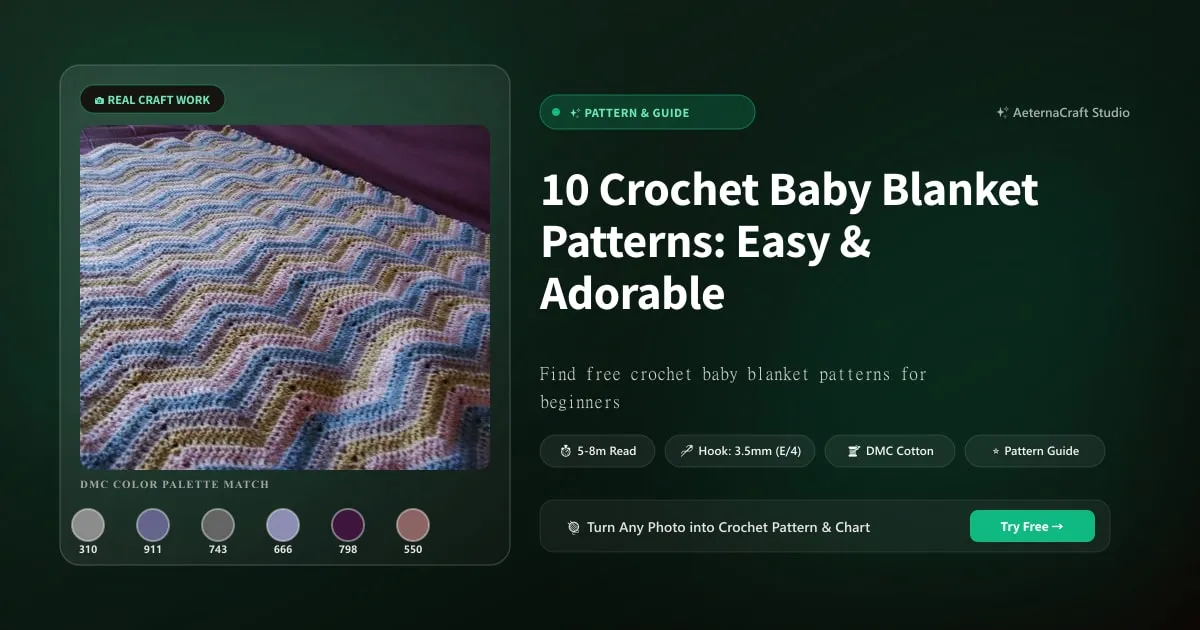
The chevron stitch is a beautiful repeat that looks impressive but is actually just a series of increases and decreases. The stitch count usually follows a multiple of 10 plus 2. For example, chain 102 gives you ten full zigzags. Row 1 works sc across. Row 2 turns, chains 1, and begins with sc in the first stitch, hdc in the next two, dc in the next two, tr in the next two, then works evenly down the opposite slope. You will notice the peak stitch sits exactly where the previous row created it. If you lose track, place a stitch marker in that peak. This pattern works up quickly on a 4.0mm hook with worsted weight acrylic, and I honestly love how cheerful it makes a nursery.
Advanced Crochet Baby Blanket Patterns for Experienced Crafters
Once you have mastered the basics and your tension has settled into a steady rhythm, advanced blankets become a wonderful creative outlet. These designs demand more attention, use finer yarns, or require textured stitch combinations that simply cannot be rushed. That is not a bad thing. Sometimes you just want a project that rewards focus.
Intricate Lace Baby Blanket Pattern
Lace blankets are delicate, dreamy, and slightly terrifying the first time you attempt them. A shell lace pattern typically relies on clusters of dc, chain spaces, and strategic skips to create openwork. For a baby-appropriate lace blanket, I recommend using a smooth cotton or mercerized cotton yarn in fingering weight. Fingering weight keeps the drape soft and the open spaces small enough that no tiny fingers will catch. You will likely work with a 3.5mm hook. If the pattern includes a chart, read it from bottom to top and right to left, marking your current row with a piece of scrap yarn threaded through the hook. Chart reading feels clumsy at first, but after three or four projects, your eyes will trace the symbols automatically. Lace also benefits greatly from blocking. Pin the finished blanket to measurement, mist it with water, and let it dry completely. The stitches will open up beautifully.
Cable Knit Look Crochet Baby Blanket
You do not need actual knitting needles to get that chunky cable aesthetic. Post stitches are your secret weapon. By working front post double crochet (FPdc) and back post double crochet (BPdc) around existing stitches, you can twist columns that mimic braided knitting cables. A typical cable panel alternates a 6-stitch right-twist over a 6-stitch left-twist, set against a stockinette-like background of hdc or sc. Use a 4.0mm hook with worsted weight yarn, and keep an eye on your stitch count. Post stitches pull the fabric inward slightly, so if your border starts to pucker, switch to a larger hook or loosen your grip. This blanket is thick, warm, and absolutely stunning draped over a glider chair.
Basket Weave Crochet Baby Blanket
The basket weave stitch is pure geometry. It uses alternating blocks of front post and back post clusters to create a woven texture that looks far more difficult than it actually is. Work a 4-stitch or 6-stitch repeat across your foundation chain, switching between FPdc and BPdc every row. The result is a sturdy, plush fabric that feels almost like a quilted throw. Because the texture hides minor tension inconsistencies, it is surprisingly forgiving even for intermediate crocheters. I keep a 4.0mm hook and a skein of DK weight wool blend ready whenever I want to make one of these. They are heavier than summer blankets, but nothing beats a basket weave on a chilly winter morning.
Tips for Choosing Yarn and Hooks for Baby Blankets
Selecting yarn for a baby blanket can feel overwhelming if you stand in the craft store aisle staring at fifty shades of cream. I have learned through trial, error, and quite a few returns that fiber content, weight, and care instructions matter more than color matching. Here is the practical framework I use every single time.
Best Yarn Types for Baby Blankets
Acrylic remains the most popular choice for baby blankets because it is machine washable, affordable, and widely available in ultra-soft varieties. Brands like Bernat Baby Blanket and Lion Brand Feels Like Butta are excellent because they are specifically tested for softness and durability. Cotton and mercerized cotton are fantastic for warm climates or babies who overheat easily. They breathe well, hold stitch definition beautifully, and do not pill as quickly as some acrylics. Bamboo blends offer incredible drape and a silky hand feel, though they can be slightly heavier when wet. Wool and alpaca are luxuriously warm, but I always check the label for scratchiness and care requirements. Pure virgin wool can be itchy, and alpaca often needs hand washing unless it is properly blended. Silk adds gorgeous sheen and strength, but it is usually too delicate and expensive for a blanket that will see daily use. My personal recommendation is a machine-washable acrylic or a cotton-acrylic blend for the safest, lowest-maintenance option.
Selecting the Right Hook Size
Hook size directly controls your fabric’s drape, warmth, and stitch visibility. A smaller hook creates a tighter, denser fabric that resists drafts but can feel stiff. A larger hook opens up the stitchwork, giving you softer draping and faster progress. If your blanket feels rigid, try going up half a size. If it looks lumpy and holey, drop down a size.
For fingering weight yarn, a 3.5mm hook works beautifully for lace or fine cotton projects. DK weight yarn pairs well with a 4.0mm hook and gives a balanced fabric for baby blankets. Worsted weight yarn is the sweet spot for most beginners, and an H/8 hook produces a classic, sturdy drape. Bulky yarn moves incredibly fast and is perfect for quick gifts, though you will need a larger hook, usually between 6.5mm and 9.0mm. Always check the yarn label first, then crochet a 4-inch swatch. If your swatch feels too tight, upgrade the hook. If it sags, downgrade.
Common Mistakes and How to Fix Them
I have made every mistake in this section at least once, and several of them more than once. The good news is that almost every crochet baby blanket issue has a straightforward fix. You do not need to rip out hours of work or cry into your yarn stash.
Why Is My Blanket Curling?
Curling usually happens for three reasons: your tension is too tight, your hook is too small for the yarn, or your stitch pattern naturally pulls inward. If you are working in sc or hdc with a tiny hook, the fabric will behave like a towel rolling toward its center. The easiest fix is to switch to a larger hook and relax your grip. You can also block the finished blanket by pinning it flat, lightly steaming or wetting it, and letting it dry completely. Adding a straight sc border often stabilizes the edges and keeps the fabric lying flat.
Uneven Edges and How to Avoid Them
Uneven edges are almost always caused by missed increases, inconsistent turning chains, or forgetting to count stitches at the end of a row. Place a stitch marker in your first and last stitch of every row. At the end of each row, count your work. If you started with 120 chains and you have 118, you dropped two somewhere. Fix the turning chain habit by treating ch-1, ch-2, or ch-3 as part of the first stitch rather than extra width. A clean border worked in even rounds will hide minor imperfections and make your edges look professionally finished.
Getting the Right Size
Standard baby blanket sizes are lovey at 24 by 24 inches, receiving blanket at 30 by 30 inches, crib blanket at 45 by 60 inches, and toddler blanket at 36 by 48 inches. To customize without doing complicated math, just work in multiples of your stitch repeat. Add 4 to 6 inches total for borders. If a pattern says chain in multiples of 12 plus 2, and you want a wider blanket, simply add another 12 chains. Always crochet a gauge swatch first, then measure your finished square. If your swatch is slightly off, adjust your hook size and recalculate your foundation chain. No guesswork required.
Frequently Asked Questions
How long does it take to crochet a baby blanket?
For a beginner working a simple striped or hdc blanket, expect about 10 to 20 hours for a 30 by 30 inch receiving size. A 45 by 60 inch crib blanket with the same stitch will take closer to 25 to 35 hours. Advanced lace or cable patterns often run 40 to 60 hours because the stitch work is slower and requires more counting.
Can I use any yarn for a baby blanket?
No, and I mean that kindly but firmly. Avoid scratchy pure wool, novelty faux-fur yarns, chenille that pills instantly, and anything with loose glitter or sequins. Babies have sensitive skin and curious mouths. Stick to soft, machine-washable fibers labeled safe for infants.
How do I care for a crochet baby blanket to keep it soft?
Wash on a gentle cycle with cold water and mild detergent. Skip the bleach and fabric softener, both of which break down fibers over time. Lay the blanket flat to dry whenever possible, especially if it is cotton, mercerized cotton, or bamboo. Acrylic can usually be tumble dried on low, but high heat can melt or stiffen certain blends.
Related Posts
5 Easy Crochet Hat Patterns for Beginners (Step-by-Step)
Learn to crochet your first hat with 5 easy patterns, yarn and hook tips, and fixes for common mistakes. Start today with simple stitches.
BeginnerHow to Crochet a Granny Square: 12-Step Beginner Guide
Learn how to crochet a granny square with my 12-step beginner guide. Includes tips for perfect corners, color changes, and joining squares.
Try Our Free Crochet Tools
Turn Your Photo Into a Crochet Pattern
Upload any photo and our AI generates a pixel-perfect crochet pattern with real yarn color matching in seconds.
Try AeternaCraft Studio Free →Calculate Yarn for Any Resize
Free amigurumi yarn & resizing calculator. Change hook, switch yarn, or scale a whole pattern — instant results with PDF export.
Open the Calculator →